Modern Analogues for Ancient Life: A Comparative Catalogue of Giant Bacteria Morphology
Modern Analogues for Ancient Life: A Comparative Catalogue of Giant Bacteria Morphology
Sep 09, 2026
Institution: UC Santa Barbara
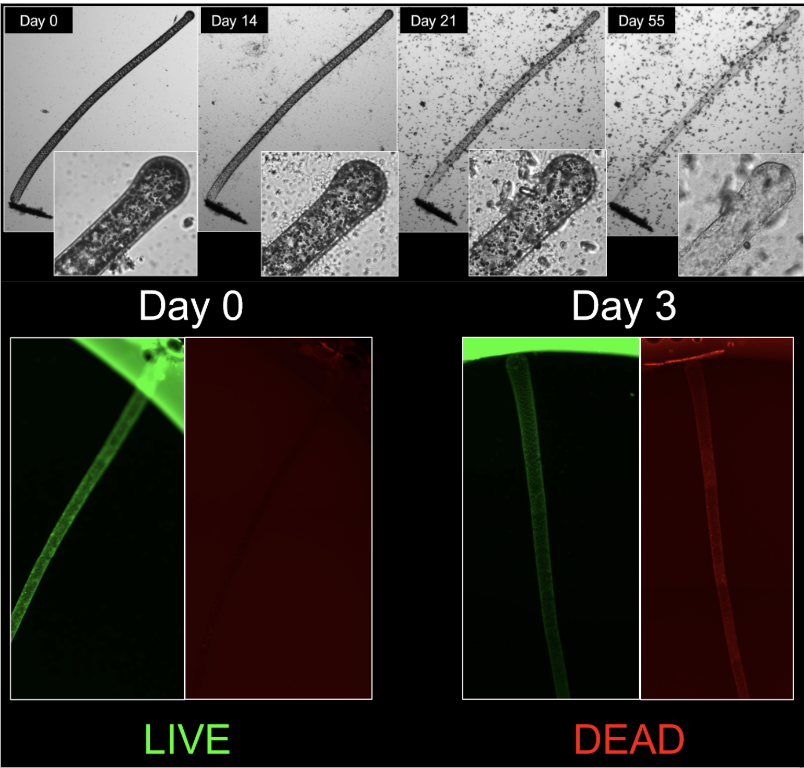
Goal:Improve how paleontologists interpret microbial fossils structures by linking modern giant bacterial diversity and decay patterns. ExFAB high-content confocal imaging was leveraged to generate high-resolution 3D image datasets of giant bacteria from sulfidic marine environments, capturing key morphological features such as overall cell shape, vacuoles, and storage granules. In the decay component, selected giant bacteria were followed for a decay experiment conducted over more than 130 days to measure structural changes such as vacuole collapse and change of morphology over time.
Impact: Broadens interpretation of fossil-like microbial structures by showing LSB can enter the fossil record. This experiment is the first and longest single cell taphonomic experiment. These data show that Giant bacteria maintain their 3D morphology and contain recalcitrant biopolymers that give them great potential to enter the fossil record. This is particularly impactful as it demonstrates that microfossils traditionally interpreted as cyano or filamentous eukaryotic cells could in fact be Large Sulfur Bacteria instead.
ExFAB Automation:
65 Filaments Images
400,000 Images Acquired
3 TB of data generated
2 automated protocols created